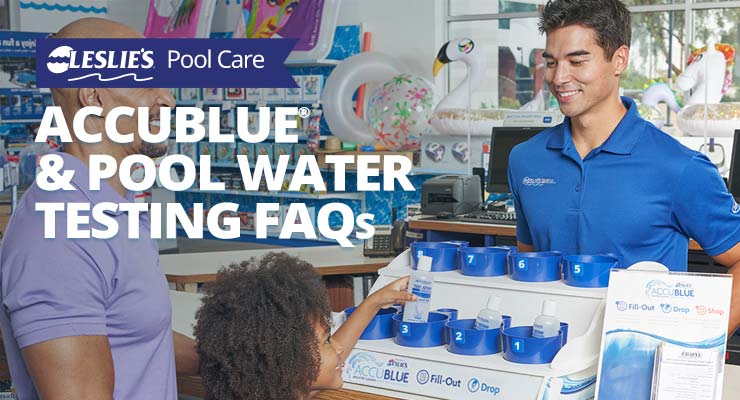
AccuBlue® & Pool Water Testing FAQs
Regularly testing your pool water is essential for maintaining a clean, safe, and beautiful pool. A consistent water testing schedule helps prevent common issues like, cloudy water, algae growth, and surface or equipment damage by ensuring that sanitizer, pH, and other chemical levels remain within ideal parameters. Leslie’s makes water testing easier than ever with our free in-store AccuBlue® test and the convenient AccuBlue Home® system.

What's the Purpose of Testing Pool Water?
Regular testing is the easiest way to ensure that your pool is safe for swimming. It helps:
- Protect swimmers by stopping bacteria and algae before they spread
- Keep water comfortable so eyes and skin aren’t irritated
- Make chlorine work better for cleaner water with less effort
- Extend equipment life by preventing corrosion and scaling
Unbalanced water decreases the effectiveness and longevity of pool sanitizers like chlorine, and limits its ability to fight off algae and germs, and prevent water-borne illnesses. In addition, poorly balanced water can be uncomfortable for swimming, and may damage pool surfaces and equipment over time.
What Do Water Tests Measure?
These are the most important water chemistry elements to test:
| Element | Why it Matters | Ideal Range | Testing Frequency |
|---|---|---|---|
| pH | Swimmer comfort & sanitizer efficiency | 7.2-7.8 | 1-2x a Week |
| Chlorine | Kills germs, bacteria, and algae | 1-4 ppm | 1-2x a Week |
| Total Alkalinity | Stabilizes pH level | 80-120 ppm | 1-2x a Week |
| Calcium Hardness | Prevents corrosion & scaling | 200-400 ppm | 1-2x a Month |
| Cyanuric Acid (CYA) | Protects chlorine from sunlight | 30-100 ppm | 1-2x a Month |
| Total Dissolved Solids (TDS) | Indicates overall water quality | 0-2500 ppm | 1-2x a Month |
| Phosphates | Main food source for algae | 0-100 ppm | 1-2x a Month |
| Metals | Cause surface stains and other blemishes | 0-0.2 ppm | 1-2x a Month |
Testing and balancing these parameters regularly keeps your pool clean, safe, and ready for swimmers.
How Do I Properly Collect a Pool Water Sample?
To get accurate water test results, start by running your pool pump for at least one hour to ensure proper circulation. Then, using a clean sample bottle, reach about 12–18 inches below the surface—roughly elbow deep—and collect the water by inverting the bottle underwater. Be sure to take the sample from a well-circulated area of the pool, away from return jets or stagnant corners. Sampling from poorly circulated spots can lead to misleading test results and ineffective water treatment.
Why is Balancing Pool Water Important?
The main reason to test your pool water is simple — to keep it clean, safe, and comfortable for swimming. Balanced water makes sanitizers like chlorine work better, preventing algae, bacteria, and irritation for swimmers.
By checking and adjusting key levels like pH, alkalinity, and calcium hardness, you’ll stop problems like corrosion or scaling before they start. Regular testing protects your pool, extends equipment life, and ensures every swim is clear, safe, and enjoyable.
What is the Best Method for At-Home Water Testing?
At-home pool water testing is a convenient way to stay on top of your pool’s daily maintenance needs. Whether you’re using test strips, test kits, or digital testers these tools help monitor basic water chemistry. However, they can leave room for error and often provide limited insight.
- Test Strips – Quick & Easy: Dip a strip, compare the colors, and check basics like chlorine, pH, and alkalinity. Test strips are convenient, but less precise.
- Test Kits – More Accurate: Dropper-style test kits use titration for detailed results. Slightly more work, but more reliable than strips.
- Digital Testers – Fast & Precise: Devices like the AquaChek TruTest give quick, accurate readings for common chemistry. More costly, but great for frequent testing.
Easy Water Testing with Leslie’s AccuBlue®
To keep your water balanced and your equipment protected, we recommend supplementing your weekly at-home tests with a free professional in-store test at least once a month. It’s a simple step that can make a big difference in your pool’s performance and longevity.
For the most accurate results, consider Leslie's AccuBlue Home® or Leslie’s FREE in-store AccuBlue® water test. AccuBlue technology analyzes 10 key aspects of your pool’s water chemistry—far more than most at-home tests or other in-store options. This precision helps you make smarter adjustments and maintain a clean, safe, and beautiful pool.
What Makes Leslie’s AccuBlue Unique?
Leslie’s AccuBlue technology stands out as one of the most advanced and accurate pool water testing systems available today. Using proprietary, industry-leading technology, AccuBlue delivers a comprehensive 10-point water analysis in just 60 seconds, right inside your local Leslie’s store or in the convenience of your home with AccuBlue Home.
Once your water sample is placed into the AccuBlue testing disk, the system uses light-based spectrophotometry to measure chemical reactions at different wavelengths. This process ensures precise readings across a wide range of water chemistry factors, including:
- Total Chlorine/Bromine
- Free Chlorine/Bromine
- pH
- Total Alkalinity
- Calcium Hardness
- Cyanuric Acid
- Metals (Copper & Iron)
- Phosphates
In addition, Leslie’s in-store experts use a TDS/salt meter to measure Total Dissolved Solids and salt levels (for saltwater pools), rounding out the full AccuBlue 10-point analysis.
Personalized Results & Expert Guidance
After testing, you’ll receive an automated water health score along with customized treatment recommendations tailored to your pool’s specific needs. If you're testing at one of our stores, a trained Leslie’s pool expert will walk you through the results and provide easy-to-follow solutions to help you restore balance and maintain crystal-clear water.
Why Choose AccuBlue Over Other Water Tests?
Unlike most at-home test kits or strips, AccuBlue offers:
- Faster results
- Greater accuracy
- More comprehensive testing
- Expert support and personalized treatment plans
Whether you're a new pool owner or a seasoned pro, Leslie’s AccuBlue gives you the confidence to keep your pool clean, safe, and perfectly balanced.
How Quickly Does AccuBlue Give Results?
With Leslie’s AccuBlue Home and AccuBlue in-store water testing systems, you’ll receive a complete and accurate analysis of your pool’s water chemistry in just 60 seconds. AccuBlue Home delivers water test results straight to the Leslie's mobile app for added convenience, while in-store AccuBlue tests provide a printed copy for easy reference before you leave the store.
Plus, your test results are automatically saved in the Leslie’s app, available for both iPhone and Android devices. This makes it simple to track your water chemistry over time and stay on top of your pool maintenance routine.
BONUS TIP: It's easy to track both in-store and at-home water test history in the Leslie's app. The app lets you monitor changes over time, spot trends, and catch imbalances early—so you can make informed adjustments before problems arise.
What's Better — Testing My Pool Water at Home or in Store?
At-home water tests are extremely helpful and convenient for the day-to-day maintenance of your pool’s basic needs. However, both test strips and test kits leave plenty of room for error. Leslie’s free in-store AccuBlue water test gives you the most accurate results available. AccuBlue precisely measures 10 different aspects of your pool’s water chemistry, which is more than can be said for most at-home water testing products or other in-store water tests. We recommend having your water professionally tested in-store at least once per month to supplement your weekly at-home tests and keep your pool water on track.
Should I Test My Pool Water After Hosting a Party?
Absolutely! After a pool party, your water chemistry can shift dramatically due to high bather loads, sunscreen, body oils, and other contaminants. These factors can quickly deplete sanitizer levels and throw off your pool’s balance.
For clean and clear water, it’s a good idea to test your pool water immediately after the event. In many cases, you may also want to shock or oxidize the pool later that evening to help eliminate contaminants and prevent cloudy water the next day.
Regular post-party testing helps maintain proper sanitizer levels, supports water clarity, and protects your pool from potential issues caused by heavy use.
Is There Anything I Need to Do Differently with a Saltwater Pool?

If you own a saltwater pool, your water testing routine is mostly the same as a traditional chlorine pool—with one key difference: you’ll need to monitor salt levels periodically to ensure your saltwater chlorine generator functions properly.
Many saltwater systems include built-in sensors that detect saline concentration. However, it’s still a good idea to manually test salt levels from time to time to verify accuracy. You can do this using:
- Saltwater test strips
- Liquid test kits
- Digital salt testers
Or, for a hassle-free option, bring a sample to your local Leslie’s store for a free professional salt level test.
Do I Need to Test Salt Levels in My Saltwater Pool Every Week?
Not necessarily. Salt levels in saltwater pools usually stay steady, so weekly testing isn’t needed under normal conditions. But heavy splash-out, backwashing, or leaks can lower salt faster, so test more often if that happens. Keeping salt in the right range ensures your chlorine generator runs smoothly and your pool stays balanced.
Does Pool Water Testing Help Prevent Cloudy Water?
While testing your pool water doesn’t directly prevent cloudiness, it plays a crucial role in identifying the underlying causes. Cloudy water is often the result of imbalanced water chemistry, such as low sanitizer levels, high pH, or poor filtration. Regular testing helps you catch these issues early and take corrective action before they affect water clarity.
To learn more, check out our popular blog post, How to Clear Cloudy Pool Water.
Can Pool Water Testing Help Prevent Algae Growth?
Yes—regular pool water testing is a key step in preventing algae. While testing alone doesn’t eliminate algae, it helps you identify imbalances in water chemistry that can create ideal conditions for algae to thrive.
To reduce the risk of algae, make sure your Free Available Chlorine, pH, and Total Alkalinity levels are consistently within recommended ranges. Additionally, keeping phosphate levels as close to zero as possible is crucial, since phosphates serve as a food source for algae. If needed, you can add a Phosphate Remover and/or an Algaecide to further protect the pool.
Learn more on our blog, Top 10 Pool Algae Prevention Tips.
How Much Pool Chemicals Do You Need to Balance Your Water?

When it comes to pool chemical dosing, accuracy is key to maintaining clean, safe, and balanced water. Always start by reading and following the instructions on each product label. Most pool chemical packaging includes dosage guidelines based on a standard pool size of 10,000 gallons.
If your pool is larger or smaller, you’ll need to adjust the dosage using simple calculations. Not sure how much to add? The pool care experts at your local Leslie’s store are here to help.
When you bring in a water sample for a free AccuBlue® water test, you’ll receive a customized printout of the results, including instructions and doses for treatment according to your pool size.
How Do I Safely and Effectively Add Chemicals to a Pool?
Properly administering pool chemicals is essential for maintaining clean, balanced, and safe water. Here’s a step-by-step guide to help you do it right:
- Test First: Check the chemistry of your water with an in-store test, AccuBlue Home, or a test kit to see what’s needed.
- Run the Pump: Keep water circulating while adding chemicals to ensure proper distribution and to prevent damage.
- Follow Directions: Always read labels for correct dosage and safety steps. Wear protective gloves and goggles when handling caustic chemicals like sanitizers and acids.
- Dilute Safely: Always follow the dilution golden rule: Add chemicals to water, never water to chemicals.
- Add in Order:
Avoid adding incompatible chemicals at the same time, as this can reduce effectiveness or cause unsafe reactions. Check out our blog article, Incompatible Pool Chemicals, for more information!
Not finding the answer to your question? Let us know! Stop by your local Leslie's today to have all of your water chemistry questions answered. Don't forget to bring a water sample with you, so our knowledgeable associates can walk through your free AccuBlue water test results with you.
JUMP IN WITH US ON SOCIAL!