How to Balance Pool Water
Whether this is your first time balancing a pool or you’ve owned a pool for many years, a helpful reference guide on how to properly balance pool water can sometimes come in handy. This isn’t just a quick synopsis. This is an in-depth look at what it takes to maintain the health of your pool water. If you're looking for a quick-reference guide that consolidates the information below, head on over to our other blog post, Pool Chemistry 101.
First, we’ll walk you through the basics:
How to prep the pool
How to calculate pool volume
How to test the water

How to balance the water
Next, we’ll do a deep dive into the different aspects of water chemistry. You'll learn about ideal testing ranges and which chemicals to use in different scenarios. We’ll also discuss how certain pieces of the water balance puzzle impact one another. Let’s get started!
1. Prepare the Pool for Testing and Balancing
Before you get started, make sure the pool water is ready for testing and balancing. Check that the water level is at least halfway up the mouth of the skimmer, and add more if needed. Remove debris from the skimmer and pump baskets.
Next, turn on the pool pump, and make sure that it’s running properly. If you have a variable speed pump, run the pump on high speed. Attempting to balance a pool that’s not circulating properly damage pool surfaces. Make sure the pool filter is clean before you proceed to the next step.
2. Calculate Pool Volume
In order to know how to properly dose your pool, you first need to know how many gallons of water the pool holds. If you don’t already know the volume of your pool, just do a bit of math to get a close estimate. First, find the cubic footage of your pool. Then multiply that number by 7.5 to find your pool volume in gallons.
BONUS TIP: An accurate depth measurement can make or break a volume calculation. If your pool has a slope, you’ll need to find the average depth in order to accurately calculate pool volume. Please note that this equation only works for pools with a constant slope from the shallow end down to the deep end: (Shallow End Depth + Deep End Depth) ÷ 2 = Average Depth
Here are a few example formulas to get you started.
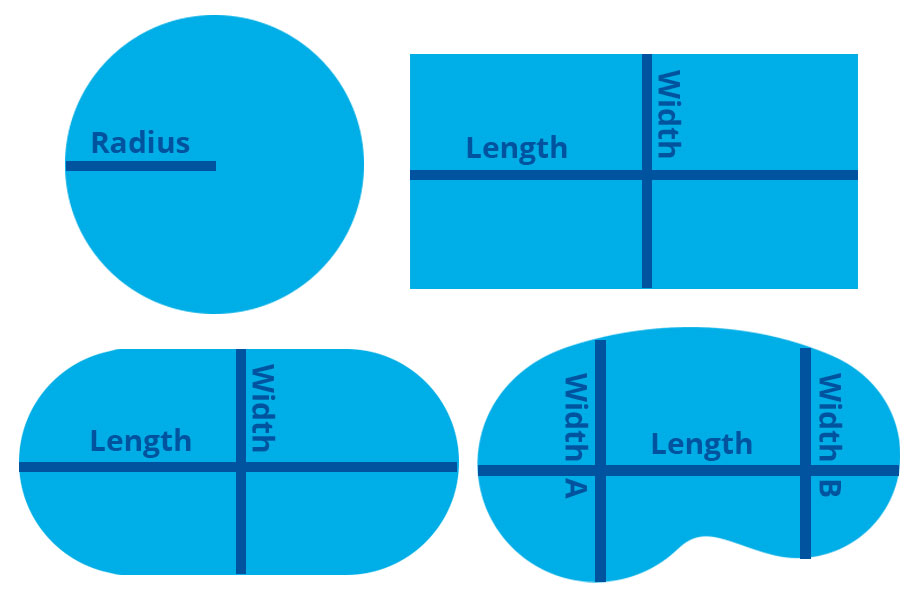
Rectangular or Square Pool
Length x Width x Depth x 7.5 = Pool Volume (Gallons)
Round or Circular Pool
3.14 × Radius2 × Depth x 7.5 = Pool Volume (Gallons)
Oval Pool
3.14 x Length x Width x 0.25 x Depth x 7.5 = Pool Volume (Gallons)
Kidney Shaped Pool
With a kidney shaped pool, measure the widest point in both portions of the kidney shape to get your A and B width measurements. Then plug those measurements into the equation below:
(Width A + Width B) x Length x 0.45 x Depth x 7.5 = Pool Volume (Gallons)
For more information on pool size or to view a quick reference chart, check out our blog post on calculating pool volume.
3. Test the Pool Water
Test your pool water at home two to three times per week, and bring a sample to your local Leslie’s once a month for a free, 10-point AccuBlue water test and customized care plan for a more complete reading.
To get the most accurate water sample:
- Run the pump for at least one hour
- Take water from 12 to 18 inches below the surface
- Avoid sampling near return jets or floating dispensers
Once you have your test results, keep track of them. Write them down in a pool journal or plug them into the Leslie’s App to monitor trends over time.
Need help with testing your pool water? Watch this video, or check out our blog post, Pool Water Testing 101.
4. Balance Your Pool Water
When adjusting the chemistry in your swimming pool, it’s important to add your chemicals in a certain order. Some aspects of water chemistry impact the balance or efficiency of others. Also, some chemicals need time to circulate before you can add other chemicals to the water. Otherwise, you may end up with an inadvertent chemical reaction that’s dangerous for you and/or damaging to your pool. By sticking to a routine water balancing format, you’ll keep your water clean, clear, sanitary, and safe.
Always follow these tips when balancing water chemistry:
- Keep the pump running on high
- Follow product label directions exactly
- Wear proper protective equipment like gloves and safety goggles
- Never mix chemicals
- Wait at least 4 hours between most chemical additions, unless the label says otherwise
- Add chemicals to water, never water to chemicals
BONUS TIP: When balancing a pool, always add chemicals to water. NEVER pour water over chemicals in an attempt to dilute them. Doing so increases the risk of bodily harm from a chemical reaction.
You won’t need to balance all aspects every time you test your pool. You may only need to address one or two, or sometimes even none at all. Follow the ordered sequence below when adding any chemicals to your pool. Always read and carefully follow product label instructions.
Metals (Copper/Iron)
Ideal range: 0 ppm
Metals can stain pool surfaces and discolor water. If copper or iron are higher than 0.2 ppm, use a chelating or sequestering agent, such as Leslie’s NoMetal, Natural Chemistry METALfree, or CuLator, to prevent staining during the balancing process.
BONUS TIP: Sequestering and chelating agents don’t just protect against metal stains. They can also help prevent unsightly calcium scale. Before you start balancing your pool water, consider if your pool is at risk, and add stain and scale prevention chemicals if necessary.
Total Alkalinity
Ideal range: 80-120 ppm
Total Alkalinity (TA) is a measure of alkaline materials in the water. It helps control pH to keep it more stable. The chemicals used to balance TA also impact pH balance, so it’s usually best to balance one and then the other, not both at the same time.
If TA is low, add Leslie’s Alkalinity Up or Leslie’s Soda Ash, based upon the pH level. If TA and pH are both low, test for metals before using Soda Ash to bring the levels up. Otherwise, use Alkalinity Up.
If TA is too high, add Leslie’s Dry Acid or muriatic acid. For fiberglass, vinyl liner, or painted pools, use Dry Acid. Once TA is properly balanced, you’ll be able to focus on adjusting the pH.
pH
Ideal range: 7.4-7.6 ppm
With Total Alkalinity in the desired balance range, it’s time to adjust your pH. A low pH means the water is acidic, which can cause corrosion, swimmer irritation, and chlorine to dissipate faster. High pH, when the water is alkaline, can reduce chlorine effectiveness, cause cloudy water, and lead to scale.
Leslie’s Dry Acid or muriatic acid will lower the pH, and Leslie’s Soda Ash will raise pH levels. For fiberglass, vinyl liner, or painted pools, use Dry Acid to lower the pH level.
Calcium Hardness
Ideal range: 200-400 ppm
Believe it or not, Calcium Hardness plays a big role in the health of your pool. If calcium is too low, water can pull calcium from plaster, grout, and concrete, which causes damage over time. If it is too high, the water can become cloudy and form scale.
Add Leslie’s Hardness Plus to increase the calcium level in your pool. If Calcium Hardness is too high, above 600 ppm, you will need to partially drain and refill your pool to dilute the level. Always consult a pool professional before you consider draining your pool. When in doubt, drain a foot of water, then add a foot of water until you reach the desired level.
When struggling with hard water, it’s important to use a scale prevention product to prevent scale buildup. Keep in mind that having a high pH, even with ideal Calcium Hardness levels, can also lead to scale buildup. Maintain proper water balance to avoid these types of issues.
BONUS TIP: Do not add Leslie’s Hardness Plus on the same day you add either Leslie’s Soda Ash or Leslie’s Alkalinity Up. Doing so can cause cloudy pool water, increased scaling on pool surfaces, and the development of small solids in the water.
Chlorine
Ideal range: 2-4 ppm

Chlorine levels in the pool are determined by two different measurements: Free Available Chlorine (FAC) and Total Available Chlorine (TAC). FAC is the amount of chlorine in the pool that’s actively keeping the water sanitized. TAC looks at the total amount of all chlorine in the water, including FAC.
If the FAC is 0.3 ppm or lower than the TAC, your pool likely has chloramines, which cause irritation and a strong chlorine odor. Use a chlorine shock, like Leslie’s Power Powder Plus, to clear them out and restore the proper FAC level. Just note that Power Powder Plus contains calcium, which will increase Calcium Hardness levels in the pool. Do not use this type of pool shock if your Calcium Hardness levels are already high.
If FAC levels are higher than 2.0 ppm, use a non-chlorine pool shock like Leslie’s Fresh ‘N Clear to oxidize the water.
Before shocking the pool, balance the Total Alkalinity, pH, and Calcium Hardness levels. This will maximize the sanitizing power of the chlorine, and will also prevent stains. Most pools need to be shocked about once a week, or more often after heavy use, storms, or algae problems.
BONUS TIP: Shocking the pool can skew water test results until the FAC level drops. Retest the pool before adding shock, or wait at least 24 hours after shocking the water, when the FAC level returns to 2.0–4.0 ppm. Don't use the pool until FAC falls within this range.
Water Clarifiers
Clarifiers, such as Leslie’s Ultra Bright Advanced, work by coagulating microscopic particles into larger groups for easier filtration. Regular applications of clarifiers help boost both filtration and sanitizer efficiency. Some clarifiers, such as Leslie’s Clear Aid, also use enzymes to break down organic contaminants in the water.
Algaecides
Whether your pool is taking on a green hue or you’re just keeping up with routine preventative measures, algae control chemicals help combat algae. If your pool is suffering an algae bloom, it’s important to determine the type of algae before treating it.
To learn more about the ins and outs of using algaecide, watch the video below, or head over to our blog post, How To Prevent and Remove Algae.
Cyanuric Acid
Ideal range: 30-100 ppm
Cyanuric Acid (CYA) protects chlorine from being destroyed by the sun’s harsh UV rays. Too little stabilizer means chlorine burns off too quickly. Too much makes chlorine less effective.
Every chlorine pool needs to start with at least the minimum level of acceptable CYA, which is 10 ppm. Stabilized chlorine (trichlor tablets or granular dichlor) will add a small amount of CYA to the pool with each application. You should only need to add more CYA if there’s a pool leak or if the pool has been drained. On the other hand, if you're using unstabilized chlorine as your primary sanitizer, additional CYA, like Leslie’s Conditioner or Instant Conditioner, will need to be added.
Just like with Calcium Hardness, if the CYA level is too high, 100–125 ppm or greater, you may need to partially drain and refill your pool. Consult with a local Leslie’s professional first.
Phosphates
Ideal range: 0 ppm
Phosphates are algae’s primary food source, so you want phosphate levels to be as close to 0 ppm as possible. If levels are higher than 100 ppb, use Leslie’s NoPHOS. Once phosphates fall below this level, use Leslie’s Perfect Weekly as part of your regular pool maintenance routine.
Total Dissolved Solids
Ideal range: 0-2500 (for chlorine pools)
Total Dissolved Solids (TDS) is the measurement of all the solids dissolved in your pool. This includes minerals, salts, and metals, as well as other inorganic and organic materials suspended in the water. The only time you need to worry about adjusting pool water balance here is if your TDS reading is higher than 2500 ppm. As TDS levels get higher, it can get progressively harder to balance the water. If the level is elevated, consult with a Leslie’s pool professional about partially draining and refilling the pool.
Keep in mind that saltwater pools will have a higher TDS level because of the higher salt content. The rule of thumb is that TDS levels should not be higher than 1500 ppm above the salt level reading.
BONUS TIP: If you have to drain water from the pool, the chemistry will change once you add fresh water back in. Once you have reached the desired levels of Calcium Hardness, Cyanuric Acid, Total Dissolved Solids, and/or salt, reassess the other aspects of water chemistry to ensure they're within the ideal range. Let the pool recirculate for at least an hour at high speed, and collect a new water sample for testing.
Salt
If you have a saltwater pool, you’ll also need to keep track of the salt concentration in the water. The ideal level varies slightly depending on the manufacturer of your saltwater chlorine generator. Some brands or models have ideal salinity levels as low as 2,500 ppm, while others require upwards of 5,000 ppm.
Check the manufacturer’s recommendations, and if levels are low, add more pool salt. To determine how much salt you need, subtract the current salt level from the desired salt level. Use this formula to get a close estimate:
- 0.0833 x (Pool Gallons ÷ 10,000) x PPM Increase = Pounds of Salt Needed
- If the result is less than 1.0, multiply your answer by 16, which will convert the amount into ounces.
BONUS TIP: Electronic salt meters often are not accurate if the water temperature is 60ºF or below. At this temperature, your saltwater chlorine generator won’t be working efficiently, either. Don’t add more salt to the pool until temperatures increase above 60ºF.
Conclusion
As you become familiar with the water balancing process, it will become easier with each test. But if you run into any issues, our knowledgeable Leslie’s associates are here to help you become a water balancing expert. Bring your questions and a water sample to your local Leslie’s, and we’ll be happy to walk you through every step of the way.
JUMP IN WITH US ON SOCIAL!